2026-10-25 · Rick Morales
How To Handle Unattended Death Cleanup In Littleton Homes
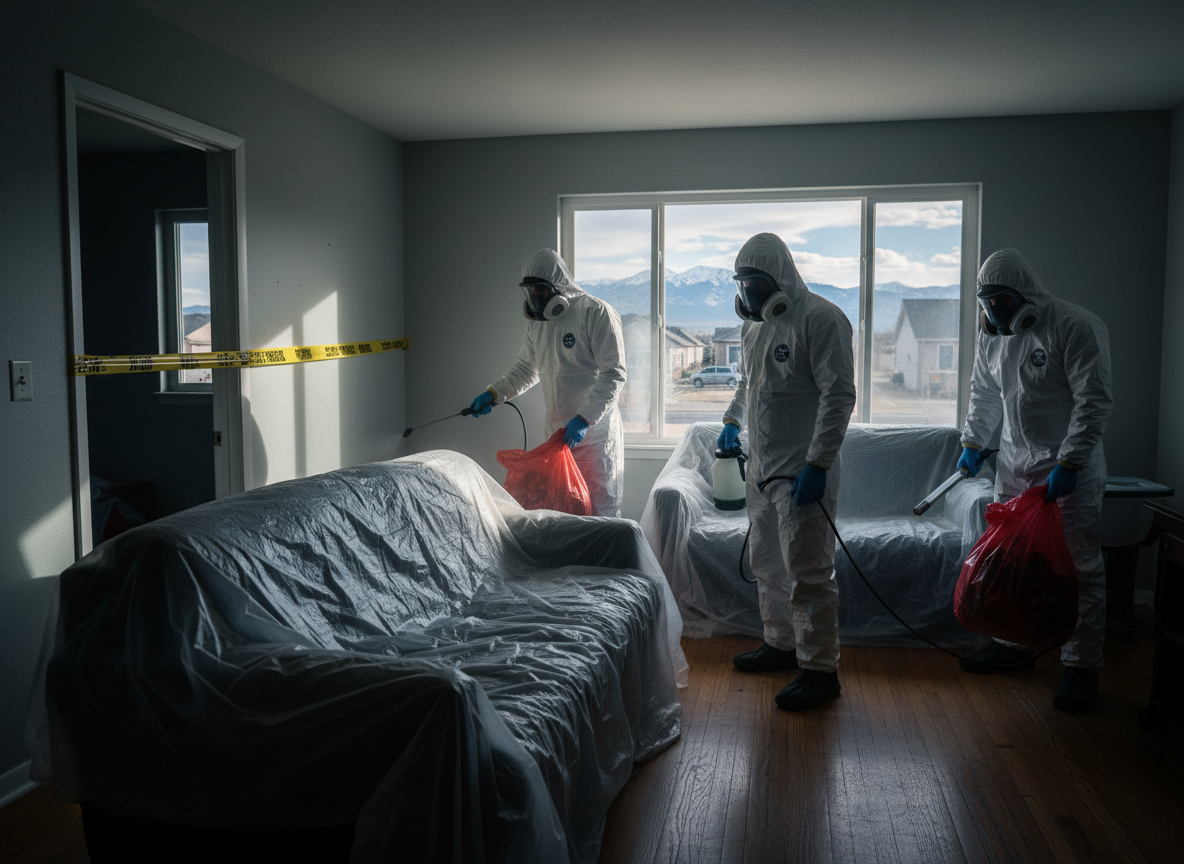
Handling unattended death cleanup in Littleton homes begins with isolating the affected space and engaging trained biohazard teams to remove fluids and tissues safely before any family reentry. Crews assess the scene size, often in single-story ranch homes common in Columbine or Southpark, then apply EPA-registered disinfectants across all porous surfaces.
Securing the Property and Initial Response
Littleton properties built before 1970 often feature carpeted basements and older HVAC systems that trap odors quickly in low-humidity air. After discovery, the first action is to limit foot traffic and shut off HVAC to prevent aerosol spread into adjacent rooms. Teams document the layout with photos while wearing full PPE, then establish negative air pressure using portable units suited to Arapahoe County wind patterns. In neighborhoods such as Wolhurst, where homes sit on larger lots with irrigation ditches nearby, crews also check soil contact points for seepage. This initial containment phase typically lasts two to four hours before deeper removal starts. Families receive clear instructions on what personal items can be safely retrieved versus those requiring disposal.
Biohazard Removal and Sanitation Steps
Removal crews extract all affected materials including subfloor sections when fluids have wicked into hardwood common in Historic Littleton homes. They apply enzymatic cleaners followed by hospital-grade disinfectants, repeating applications based on dwell times required for bloodborne pathogens. In semi-arid conditions with four distinct seasons, rapid drying prevents secondary mold growth once temperatures drop below freezing. biohazard disinfection service teams use HEPA vacuums on remaining surfaces and treat HVAC ducts when contamination reaches registers. Work in Sterne Park bungalows often includes checking crawl spaces where moisture from summer monsoons can linger. Every step follows written protocols that crews update after each job to match actual site conditions rather than generic checklists.
Addressing Odors and Long-Term Effects
Residual odors from decomposition penetrate drywall and insulation in older Littleton stock, requiring ozone or hydroxyl generators run for 24 to 48 hours after physical removal. Crews test air quality with handheld meters before allowing reoccupancy, especially in homes near Hudson Gardens where afternoon winds can push treated air outward. dead animal removal and odor removal techniques adapt here because the same enzymes break down protein residues left by unattended deaths. Low humidity helps drying but can leave crystalline residues that re-emit smells when humidity rises in spring. Homeowners in Englewood-adjacent areas sometimes request follow-up visits after the first freeze-thaw cycle reveals hidden pockets.
Navigating Arapahoe County Disposal Requirements
All biohazard waste from Littleton scenes must travel in labeled, leak-proof containers to permitted facilities rather than standard landfills. Littleton Rules For Disposing Of Biohazardous Waste From Residential Properties outline manifests that crews complete before leaving the site. Cost Factors For Bio Hazard Cleanup In Littleton Colorado often tie directly to waste volume and number of rooms involved, with larger jobs in Denver-border homes requiring multiple transport runs. Crews coordinate with county health inspectors when scenes involve shared walls in multi-unit buildings found in Downtown Littleton. Documentation includes before-and-after photos plus chain-of-custody forms kept on file for regulatory review.